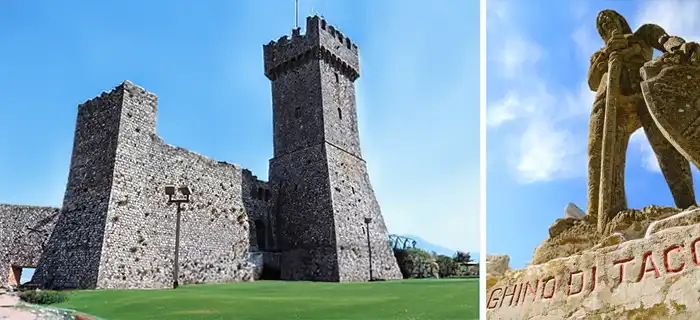
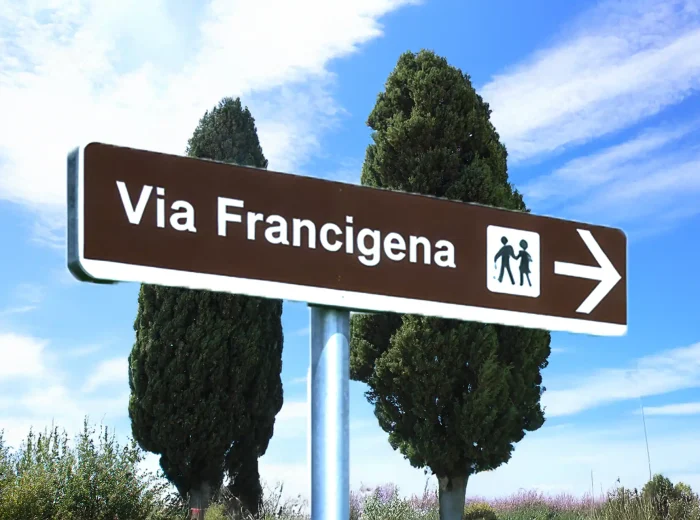
The Radicofani stage deserves a special mention. Perched on a dominant hill, with its imposing fortress, it was one of the key locations for monitoring the passage of pilgrims. Spirituality, power and hospitality are intertwined here. Radicofani offered hospitality, but also rules and protection along one of the most challenging stretches of the path. The Radicofani Fortress, perched on the top of an ancient volcano, is still a powerful visual landmark and can be seen from much of the Val d’Orcia.
Radicofani and Ghino di Tacco
The fortress’s fame is also linked to the figure of Ghino di Tacco, who lived between the late 13th and early 14th centuries. Ghino was a Ghibelline nobleman of Sienese origin and he transformed the fortress into a base from which he monitored and sometimes attacked travellers and the powerful, often sparing the poor and pilgrims, based on his own code of justice. This fame earned him the nickname “gentleman brigand”.
His adventures are narrated by Dante Alighieri and Giovanni Boccaccio. According to tradition, his parable ended in a reconciliation with the ecclesiastical authorities: he obtained papal pardon and was named knight and prior of the hospital of Santo Spirito in Sassia in Rome.
In contemporary times, politician Bettino Craxi adopted the nickname Ghino di Tacco, attributed to him by journalist Eugenio Scalfari, using it in an editorial in the newspaper “Avanti!” and establishing a special relationship with the village of Radicofani.
The Medici Villa of Radicofani: a haven for pilgrims
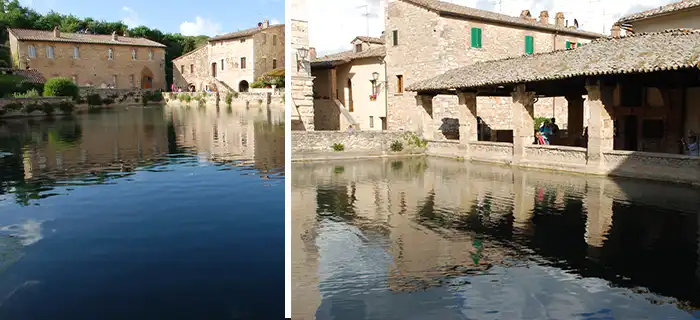
In Radicofani, located along one of the most challenging stretches of the Via Francigena, the Medici Villa testifies to the village’s central role not only as a place of military control, but also as a place for assisting and sheltering pilgrims. Commissioned by the Medici family between the 16th and 17th centuries, the building was part of the grand ducal policy of protecting the routes of communication, providing safety for travellers and organising hospitality. Currently privately owned, it is being renovated and repurposed as a hospitality venue. A precious Medici fountain is also located in front of the villa.
Bosco Isabella (Radicofani): symbolism and contemplation
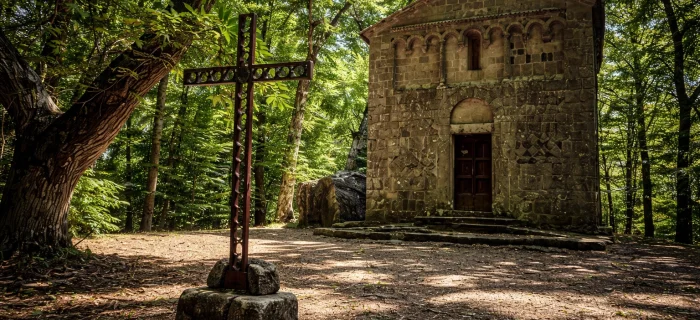
Bosco Isabella, one of the most evocative historical gardens in the Val d’Orcia, extends along the ancient route of the Via Francigena. Strictly speaking, it is not a natural forest, but a romantic 19th-century park, conceived as a place for walking, meditation and rest. This park was created in the second half of the 19th century by Odoardo Luchini, who dedicated it to his wife Isabella, and combines nature, architecture and imagination, emerging as a true “traveller’s garden”.