Pienza: the realization of the ‘ideal city’
Pienza is one of the most remarkable examples of Renaissance urban planning in Italy
In 1459, the medieval village of Corsignano was transformed at the will of Pope Pius II, who was born here and wished to bring to life the humanist ideal of the perfect city.
For this reason, he commissioned the architect Bernardo Rossellino, a pupil of Leon Battista Alberti, to redesign the town center according to new principles: order, proportion, harmony, and a relationship with the surrounding landscape.
The “Ideal City” Project
The intervention was not a random expansion, but a precise and coherent plan.
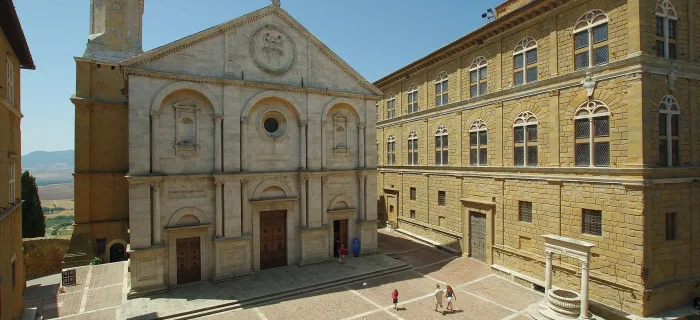
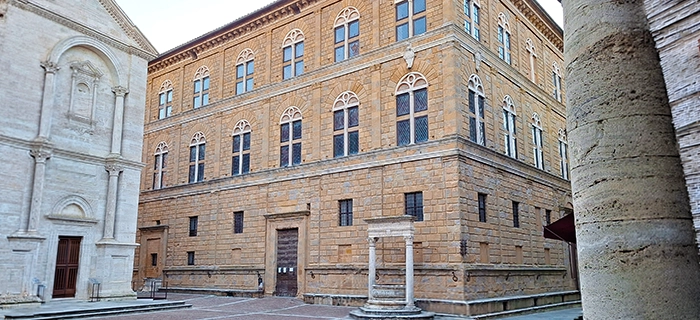
At the heart of the village, a monumental square was created – today Piazza Pio II– around which the main buildings are arranged in perfect perspectival balance. The square has a slightly trapezoidal shape, designed to visually correct perspective and create a sense of perfect harmony.
Here stand:
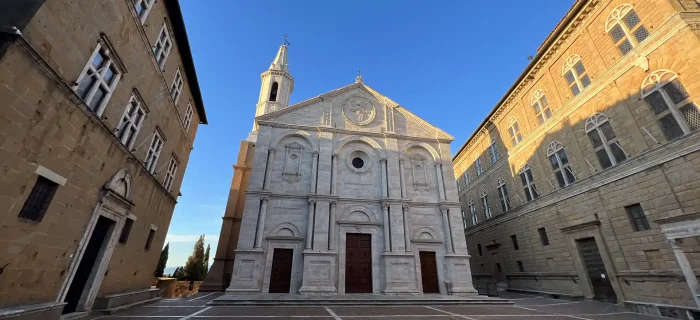
- the Cathedral of Pienza, bright and innovative for its large windows;
- Palazzo Piccolomini, the papal residence with a loggia and a garden overlooking the valley;;
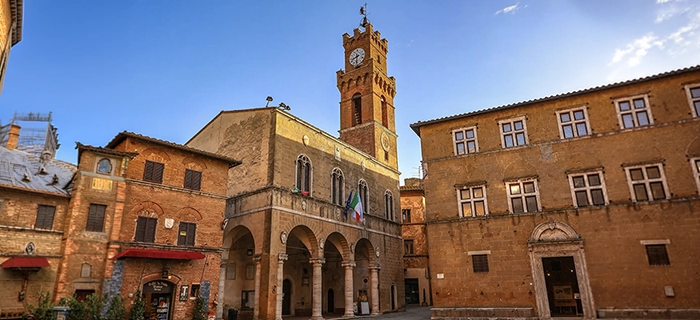
- the Town Hall, with its civic tower;
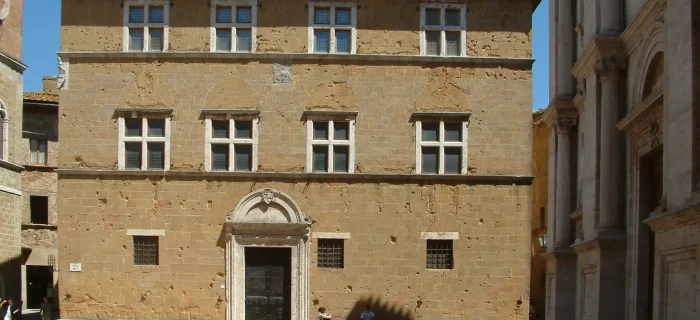
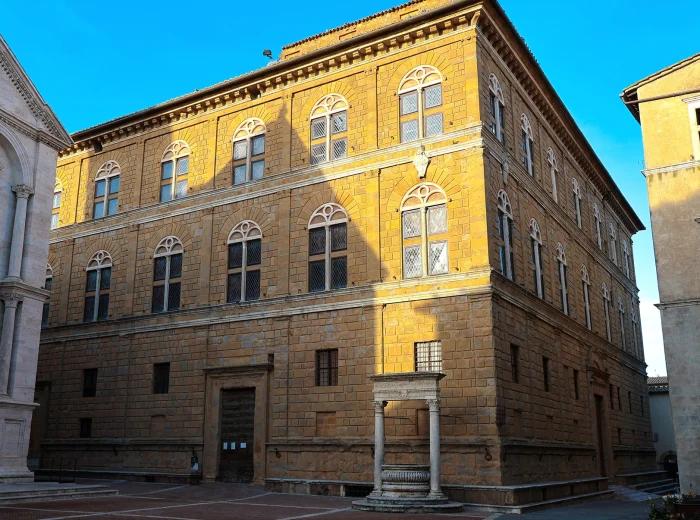
- the Palazzo Vescovile (also known as Palazzo Borgia).
The main stops of the visit
The Cathedral of Pienza, dedicated to Santa Maria Assunta, was built between 1459 and 1462 as part of the project commissioned by Pope Pius II.
Although fully Renaissance in its façade and urban layout, the interior has a surprising feature: it recalls the Gothic style of German Hallenkirchen, which the pope had encountered during his travels in the German-speaking regions, particularly in Aachen.
Inside, you will find:
- Three naves of similar height (hall church structure);
- Large vertical windows flooding the space with light;
- Slender pillars;
- Ribbed vaults.
The cathedral thus represents a unique fusion between:
- Italian Renaissance façade (order, proportion, balance);
- Interior space inspired by German Gothic architecture.
This synthesis reflects the cosmopolitan biography of Pius II and his desire to create a modern, international city.
Structural Issues
The apse of the cathedral has had structural problems since its construction. The building sits on the edge of the ridge overlooking the Val d’Orcia, on clayey and friable soil prone to movement and landslides.
Today, the area is constantly monitored using:
- Crack gauges to track fissure openings;
- Movement sensors;
- Periodic surveys using laser and geotechnical technologies.
The Palazzo Vescovile was intended as the episcopal residence, since Pienza became a diocese by the will of Pope Pius II.
It is also called “Palazzo Borgia” because, in the late 15th century, it was inhabited by Cardinal Rodrigo Borgia.
The design is attributed to Bernardo Rossellino. Compared to the nearby Palazzo Piccolomini, it appears more sober and less monumental, with a regular stone façade.
Architecture and Landscape
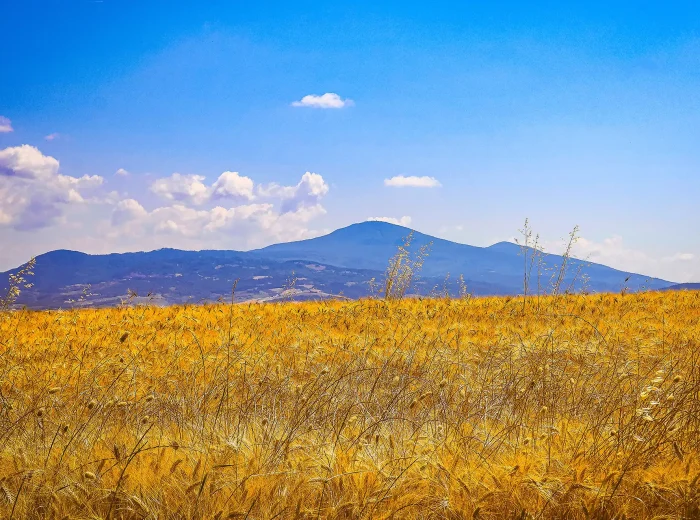
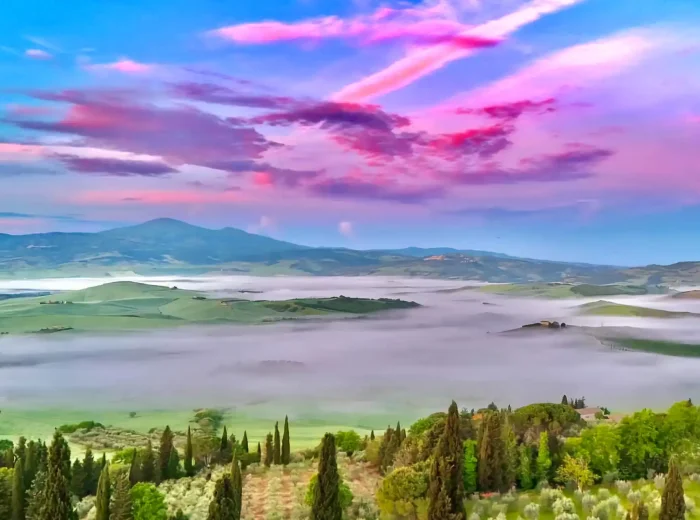
One of the most innovative elements of Renaissance Pienza is its relationship with the Val d’Orcia.
Palazzo Piccolomini and the southern streets do not turn inward but open onto the panorama. The landscape becomes an integral part of the architectural composition: nature is “framed” like a painting.
This vision reflects 15th-century humanism: the city must be measured by man and in harmony with the natural world.
A Brief but Revolutionary Intervention
The main works took place between 1459 and 1462, in just a few years. The death of Pius II interrupted the broader project, but the heart of the city remained an exemplary model—one of the rare “ideal cities” realized during the Renaissance.
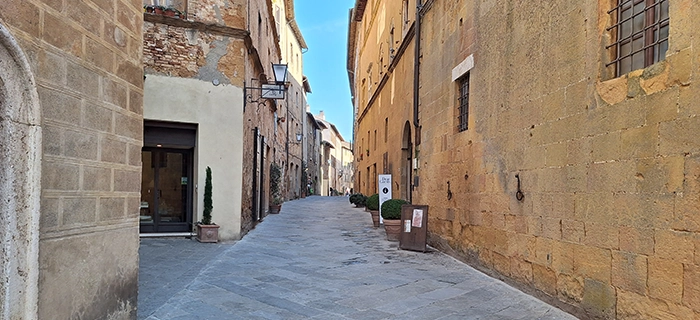
Unlike many Tuscan towns that grew spontaneously and irregularly in the medieval period, Pienza features:
- Stylistic coherence;
- Carefully calculated proportions;
- A unified urban layout.
Why is it so important?
Pienza is one of the very rare cases in which the theoretical idea of a Renaissance “ideal city” was actually realized, not just drawn in treatises.
It is not just a beautiful town: it is a political, cultural, and architectural manifesto of the Italian Renaissance.