This water-themed excursion starts in Bagno Vignoni, a hamlet of San Quirico d’Orcia, a spa town of Etruscan-Roman origin, frequented along the Via Francigena by medieval pilgrims heading to Rome and still today a popular wellness resort with a romantic charm.
1. Bagno Vignoni and its thermal baths
This water-themed excursion starts in Bagno Vignoni, a hamlet of San Quirico d’Orcia, a spa town of Etruscan-Roman origin, frequented along the Via Francigena by medieval pilgrims heading to Rome and still today a popular wellness resort with a romantic charm.
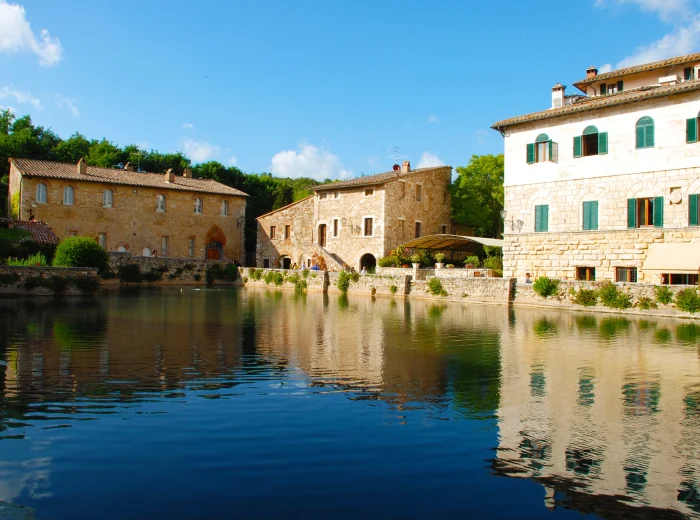
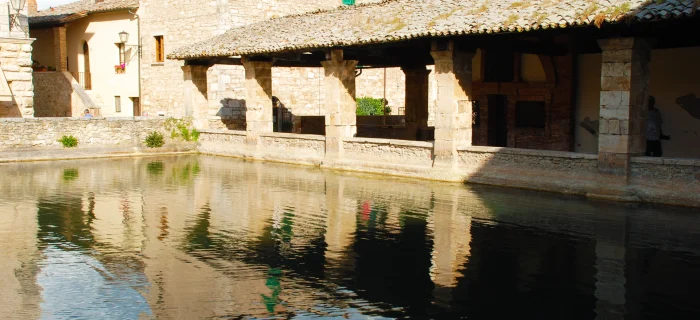
The village’s main feature, making it truly unique, is the large thermal bath in the centre, forming a real square made of water. In centuries past, bathing was possible, as evidenced by the steps carved into the rock along the longer sides. Today, however, it is a monument. Around it, there are houses, restaurants and buildings, including the 15th-century Palazzo Piccolomini, now a hotel, which also hosted illustrious figures like Lorenzo the Magnificent. The façade of the small Church of San Giovanni is also part of the scenic backdrop around the bath. Along the shorter side of the bath, under the loggia, is the chapel of Saint Catherine of Siena, who frequented these baths in the 14th century to mortify her body with boiling water.
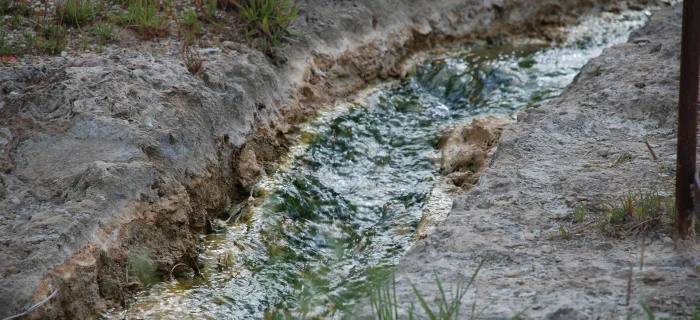
The bath is fed by a volcanic spring below, with waters rich in magnesium and calcium sulphates, which have beneficial effects on the bones. It flows at around 50°C (120°F), becoming warmer at the surface. Once the bath is full, the water continues its course, guided along a covered canal that carries it downstream, along the Via del Gorello. In the Parco dei Mulini area, the small canal – the gorello – splits in two. On one side, the water continues to flow downhill, becoming a waterfall and cascading down towards the Orcia River. This is the spot where you can soak your feet for a pleasant massage at the end of a day’s walking. On the other side, the canal is now kept dry, but in ancient times it fed two connecting baths, one of which had a hole in the bottom.
The pressure of the water flowing out as if from a funnel turned the wheel of a mill to grind grain. Another gorello canal provided water to showers, used by travellers, which were visible from above. Basically, it was a sophisticated system of connecting canals that used every single drop of water. In the archaeological area, the foundations of a medieval tower still remain, indicating the presence of the mill.
A signposted hiking trail leads down to the valley as far as the mother-of-pearl-coloured natural pools, where you can bathe freely.
The pure clay bed of the pools has skin-purifying properties.
2. Rocca d'Orcia
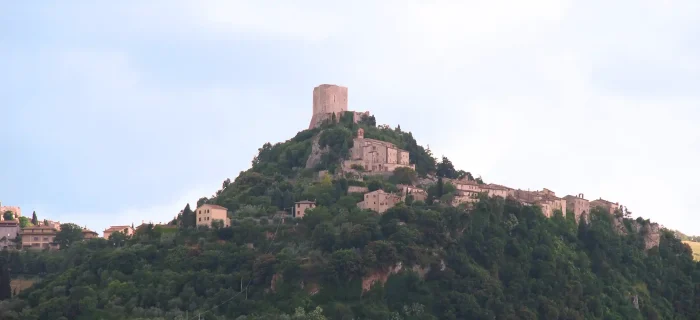
Heading towards the Via Cassia SS2 state road, you need to ford the Orcia River, more or less under the road bridge, and then climb towards the Vecchia Posta (originally an ancient post office) in the direction of Rocca d’Orcia,, a hamlet of Castiglione d’Orcia, tackling a significant elevation gain through fields, olive groves and woods.
The vegetation consists of holm oaks and oak trees. Great care must be taking when fording the river and it must be done at the shallowest point, depending on the season. There is no preferred path leading up to Rocca d’Orcia, an ancient village dominated by a large 13th-century fortress, known as Tentennano, built by the Tignosi family, later passed to the Salimbeni family and lastly to the Republic of Siena. Today, it can be visited.
The uphill climb is steep, but the view from the top is worth the effort. The village can be entered from the Porta Senese, where Borgo Maestro, the main thoroughfare, begins. Narrow streets, alleys and flights of steps wind steeply up the slope, leading to the central square named after an ancient cistern. The main church is that of San Simeone, which you can enter via a flight of steps.
The interior features interesting votive frescoes from various periods. At the top of the village stands the mighty fortress, built on a sheer cliff overlooking Bagno Vignoni and much of the Val d’Orcia. The fortress was once home to Saint Catherine of Siena, who came to reconcile the Salimbeni brothers. According to tradition, it was here that the saint miraculously learned to read and write.
3. Castiglion d'Orcia
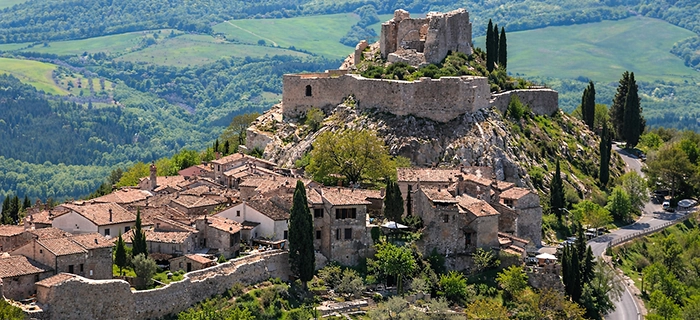
A short, easy walk connects the fortress to the main town of Castiglion d’Orcia, which also contains the ruins of a medieval tower built in the 11th century by the powerful Aldobrandeschi family, recently renovated and open to the public.
The Aldobrandeschi family dominated the Monte Amiata area and this tower was an important garrison for monitoring the roads leading down to the Maremma region, all the way to the sea.
They sold it to the Republic of Siena in 1301.
The Sala d’arte San Giovanni is an art museum also worth visiting. It contains a few valuable works by Simone Martini, Pietro Lorenzetti and Vecchietta, the greatest Sienese painters of the 14th and 15th centuries.
4. Return to Bagno Vignoni
To return to Bagno Vignoni, you need to go back down towards the river and cross it again. An alternative route is the Strada dei Perelli. During your descent, proceeding with the river on your right, you’ll see the Ripa d’Orcia Castle up above. Although it’s interior is not open to visitors, it offers a stunning panoramic view. As you ford the river, you’ll come across blocks of limestone and travertine shaped by the water and, while going back up towards Bagno Vignoni, you’ll encounter the remains of an ancient, disused travertine quarry.
Once back in Bagno Vignoni, if you want to extend the hike, you can climb up to the Vignoni Alto Castle along the little-used unpaved road. Vignoni Alto is a charming fortified medieval village, with the little church of San Biagio built into its walls near one of the gateways. At the edge of the village, the truncated tower of the keep still remains, with its steeply sloping scarp base.