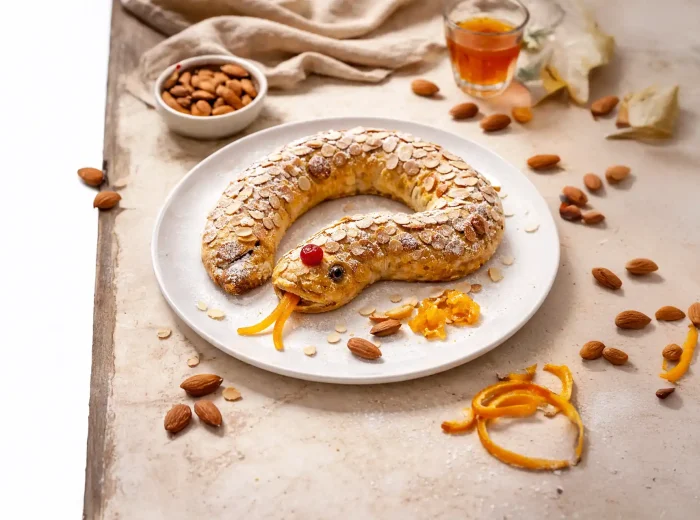
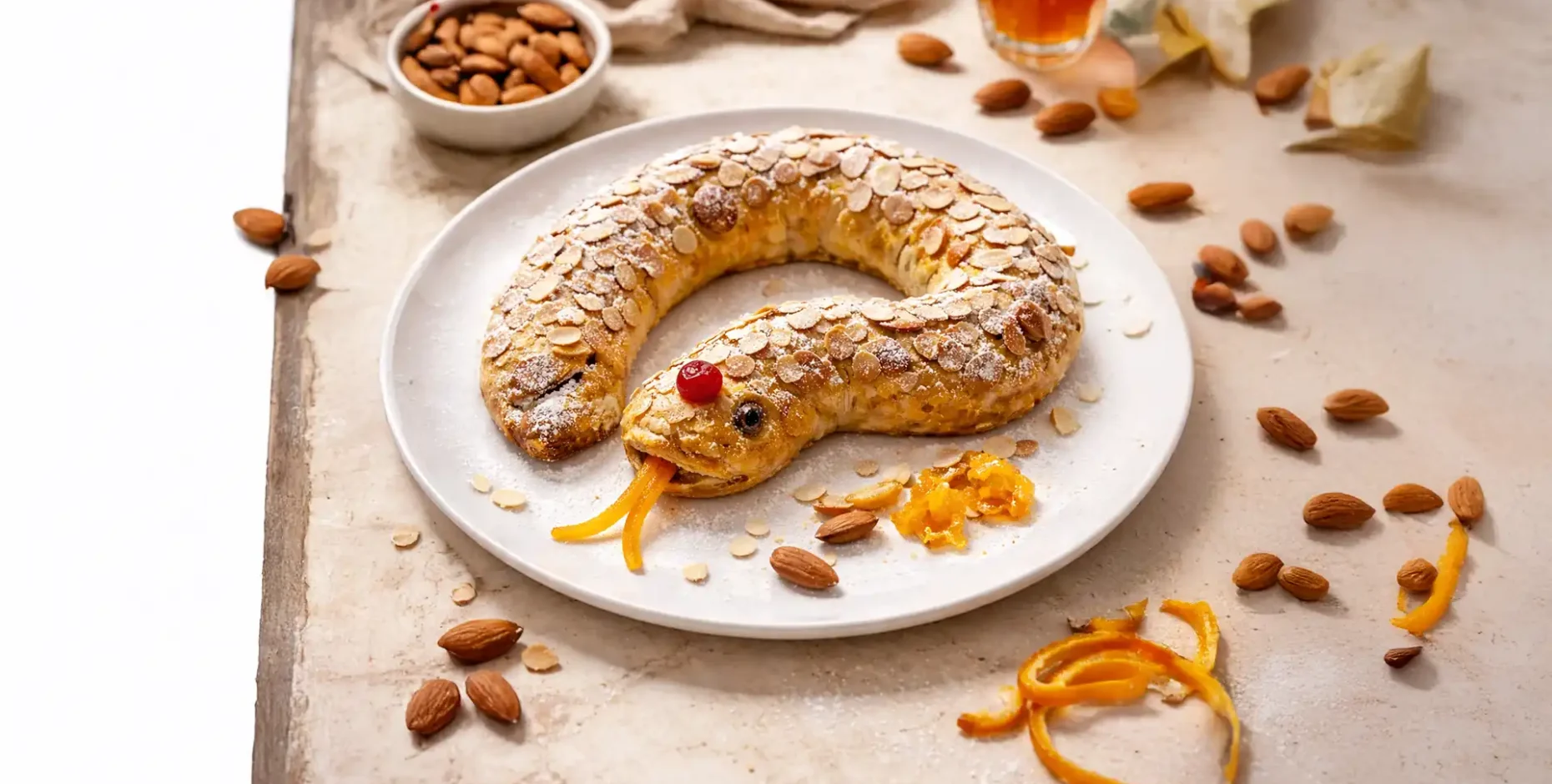
Almonds, sugar, egg whites beaten until stiff, candied citrons, raisins and pine nuts: These are the ingredients needed to make the Serpe di Pienza, a typical local pastry, the origins of which have been lost in the mists of time.
 Ingredienti
The dough is mixed, kneaded and made into a curved cylinder that will take on the appearance of a snake. The head is given a triangular shape and the tail is narrowed at the end. The body is decorated with pine nuts to resemble the scaly body of the reptile, the tongue is created with candied fruit and the eyes are made from two coffee beans or raisins. The ears are clearly defined with pieces of candied fruit, almost like two small wings.
 Curiosity
In local folklore, the snake is always the subject of fantastic tales and stories, like the typical traditional Tuscan story of a small snake that moved around the woods to scare the farmers, who could only ward it off by using a mirror to reflect its negativity and the evil spells it could cast if encountered. It is described as a glistening reptile with scales and two small wings positioned near its ears. The serpent also appears in Romanesque architecture, like the Parish Church of Corsignano; here, it is identified as the Serpe Regolo, the Greek-Roman divinity linked to earth cults and is a pagan symbol of Wisdom.
In other areas of central and southern Italy, a similar dessert is made but with shortcrust pastry or a different dough. The almond-based mixture used for this Pienza version is a characteristic unique to this area, where numerous almond trees have flourished since the days of Pope Pius II. There are a great many nineteenth-century documents describing the trade of the finest almonds in this territory.
Despite the legends, popular traditions and peasant rituals that saw the figure of the snake as the representation of good and evil and of danger and temptation, the Serpe di Pienza is now not only an excellent sweet product, but it is also a precious gift if given as a symbol of good luck, strength, wisdom and renewal.
 Accompaniments
This sweet speciality is perfect when eaten with raisin wine or Vin Santo dessert wine and can be enjoyed with dried fruit such as walnuts, pine nuts or local liqueurs.