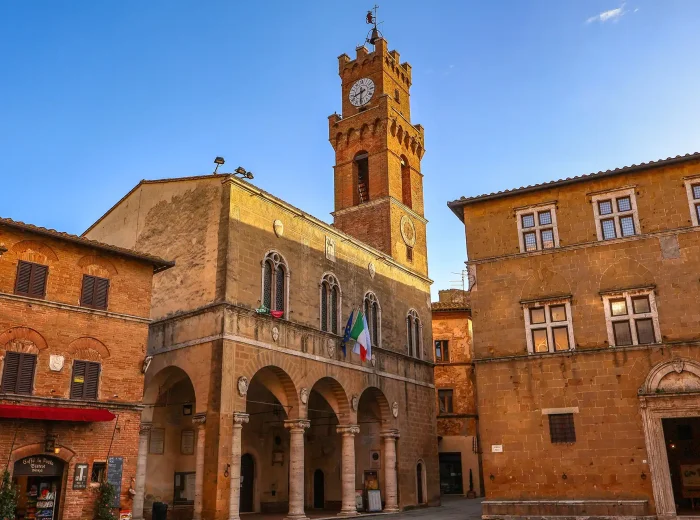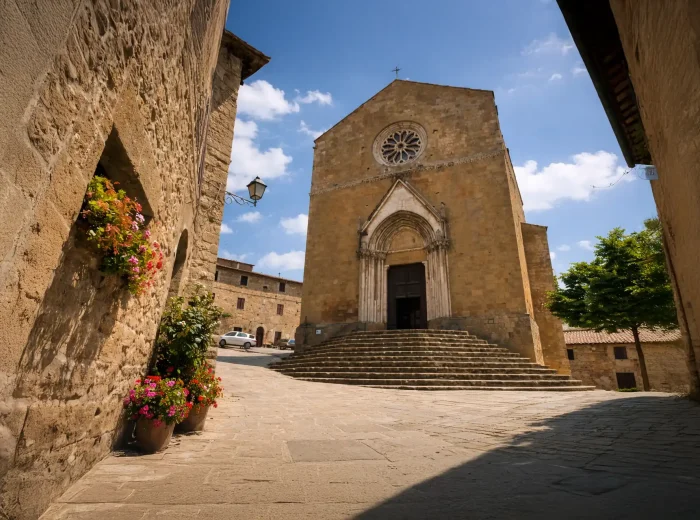
The first historical record of Monticchiello dates back to 973, when it appears in the list of castles and courts given up by Lamberto Aldobrandeschi, son of Marquis Ildebrando, to the priest Ropprando.
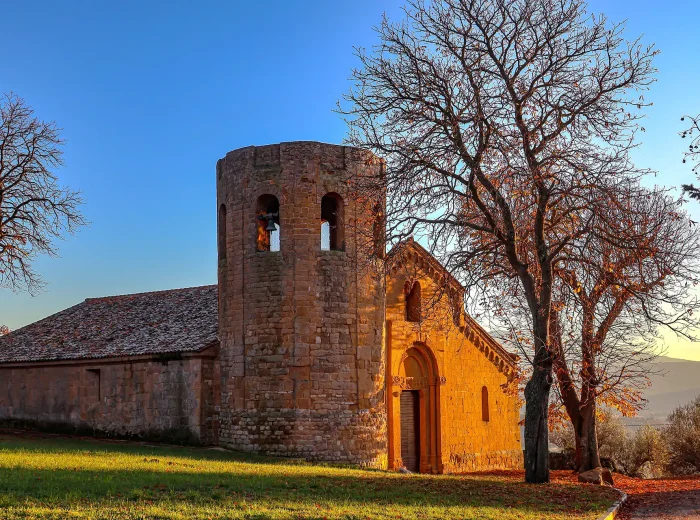
Until the 13th century, the history of this important castle – site of the Baptismal Church of San Leonardo – remains largely obscure.
In 1156, Count Paltonieri di Fonteguerra donated the castle to Pope Adrian IV, who later returned it to the count as a benefice. Later on, the castle seems to have passed from the Apostolic See to the Order of the Teutonic Knights.
From 1259, the Republic of Siena decreed the strengthening of Monticchiello’s defences, ordering the construction of a fortified fortress. In 1271, the Consiglio della Campana (Council of the Bell) resolved to send a giusdicente (judicial official) under the authority of the Podestà of Siena, confirming the strategic importance of the place.
In 1283, during tensions with Montepulciano, the Ghibellini exiles from Siena, after occupying Montefollonico, also demanded Monticchiello’s surrender. In 1233, the castle’s consuls had already sworn loyalty and alliance to the Podestà of Siena, confirming the village’s permanent position within the Sienese sphere of influence.
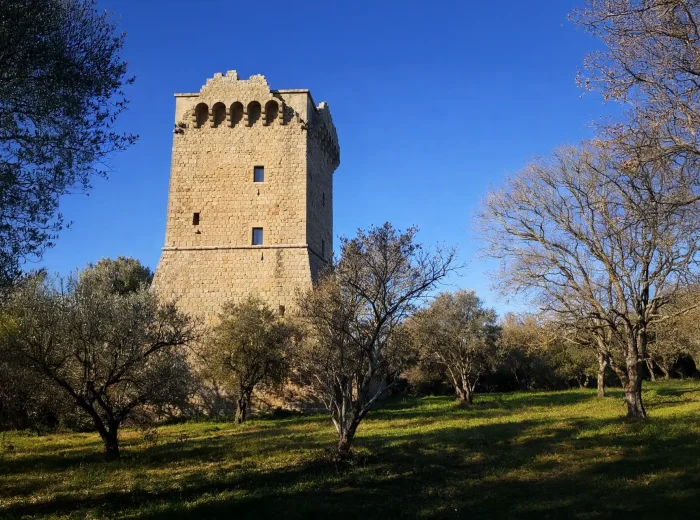
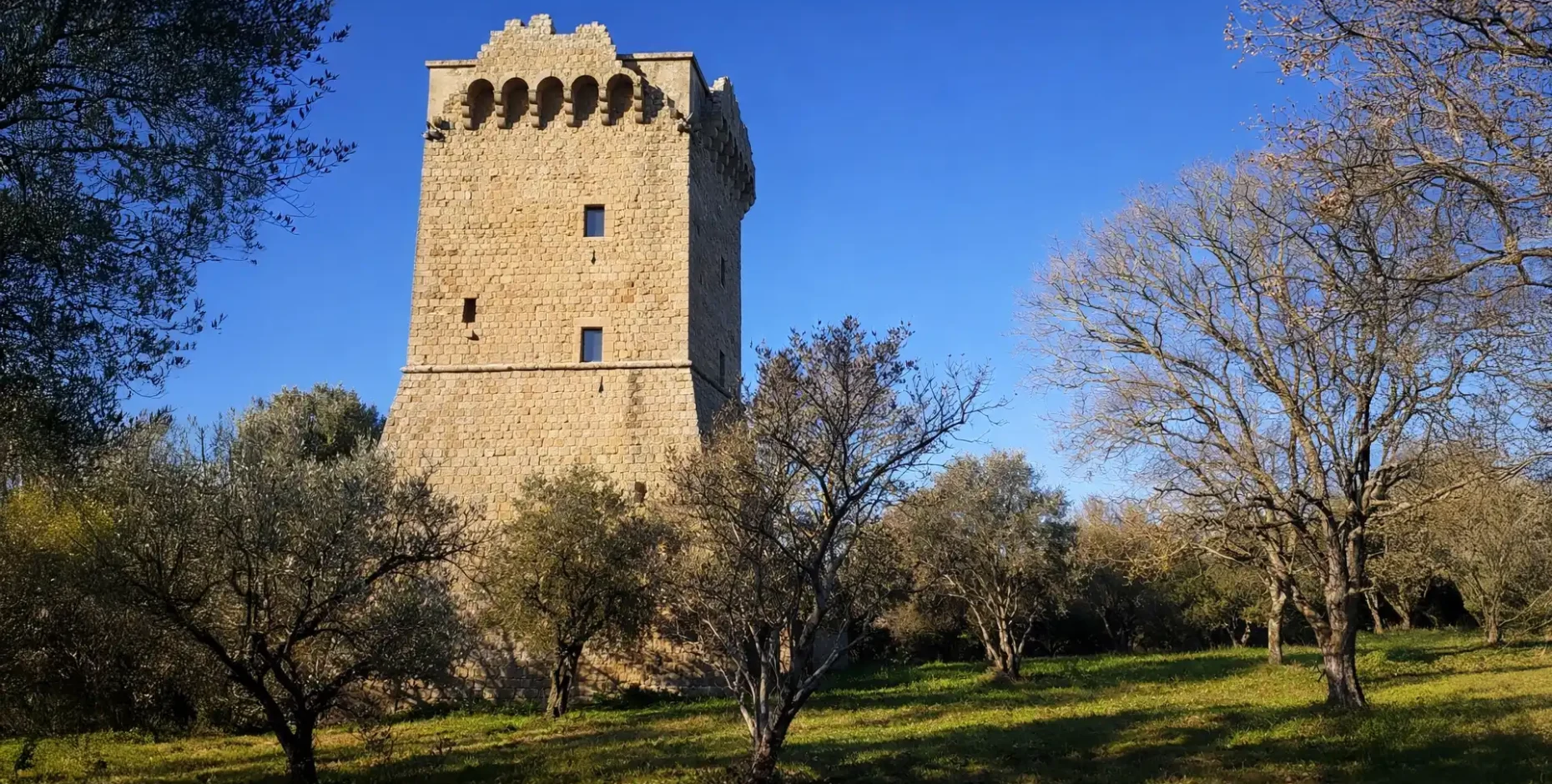
Around 1350, the main tower took on its current appearance, visibly leaning, probably due to land subsidence or telluric movements. Documentation provides evidence of inspections and consolidation work ordered by the Republic di Siena, a sign that the building was deemed essential for the defence of the territory.
In 1502, the castle was conquered by the troops of Cesare Borgia, known as Valentino (The Valencian), and the garrison was massacred. Monticchiello then played a leading role during the Sienese war, finally falling to the assault of imperial forces in 1553 after long and tenacious resistance.
The Keep, the walls and the system of defence
The Keep is all that remains of the original castle and the complex system of defence that surrounded Monticchiello. Built in the second half of the 13th century under the influence of the Republic of Siena, it served as a fortress and a strategic garrison, in a dominant position over the Val d’Orcia.
The Tower of the Sienese Keep
The Tower of the Keep is the most imposing element still visible: this massive structure that dominates the village was the centre of the system of defence.
- Date: around 1260
- Direct connection to the village’s boundary walls and watchtowers
- Highest and most fortified part of the entire complex
Monticchiello still retains a large part of its medieval boundary walls, with several integrated towers. Many of these are now privately owned, as was the tower of the Keep until 2019.
In the Middle Ages, Monticchiello was a key defensive stronghold for the Republic of Siena in the Val d’Orcia, especially during the conflicts with Montepulciano and in the disputes between Siena e Florence.
The original layout of the Keep
Important evidence of the overall layout of the Keep at its peak of development is provided by the sixteenth-century survey by engineer Jacopo Fusti Castriotto.
The drawing shows a square-plan defensive complex with four towers in the corners:
One inside the village and three built on the walls, at regular intervals. On the summit plateau of the hill, inside the ancient castle, the ruins of what may be the collapsed remains of the three bastions and sections of the outermost walls are still visible.
20th-century restoration and public restitution
In the 1960s, the Tower of the Keep became the private property of Finnish sculptor Heila Hiltunen, who turned it into a holiday residence and workshop.
The renovation, conducted under the supervision of the Superintendence of Siena, is documented in a 1970 project and has given the tower a residential structure:
- The addition of two intermediate floors made of metal beams and brick;
- The construction of plasterboard partitions on the top floor;
- internal wooden stairs.
The wall damage was treated with cement mortar; the monitoring slides installed did not detect any further movements, indicating structural stability.
The missing corners were reconstructed in reinforced concrete, a deliberately recognisable and philologically legible choice.
In July 2019, the tower was acquired by the State Property Administration, thanks to joint intervention by MiBAC (Ministry of Culture) and the Superintendence, thus returning it to public ownership.
The Keep today
The Keep complex and the surrounding park (about one hectare) occupy the highest and most panoramic part of the village.
The Keep of Monticchiello is a symbol of identity for the local community, a true “stone giant” that has contributed to the formation of the village’s collective consciousness. It is, at the same time, a monument of great value as an example of military architecture and also for its extraordinary visual relationship with the Val d’Orcia landscape.
- The walls and the Keep area can be visited externally
- Special openings of the park of the Keep are planned and organised by the Superintendence of Siena
- A recovery project financed by the Tuscany Region has made the entire patrol route around the walls accessible and lighting has been added, with views of the Val d’Orcia and towards Montepulciano, as far as the Tower of the Keep: This itinerary was inaugurated on 31 July 2022 with the participation of the President of the Region and the Superintendence of Siena.